


DS4M – Data Space For Mobility

Access DS4M

Kit Digital – Data Space

On 16 July, the regulatory framework for a new grant scheme under the Data Kit programme was published, aimed at promoting the creation and management of Data Spaces.
Its objective is to support SMEs and organisations in adopting digital solutions that improve interoperability, the secure exchange of information and the advanced use of data.

With this funding, public bodies and businesses can:

Integrate into digital ecosystems more efficiently.

Optimise decision-making through shared data.

Comply with European standards on digitalisation and security.

Information and participation
For further details about our project or to find out about the conditions for participating in our data space and accessing the Data Spaces Kit grant programme, please contact us by email at: info@ds4m.es.

The future of digital mobility is already underway

DS4M CENTRAL is a strategic national project that drives the digital transformation of mobility through the creation of shared data spaces. Funded under the 2024 call for digitalisation grants, DS4M CENTRAL connects key players in the transport ecosystem to improve the management, planning and sustainability of the mobility system.

What is DS4M CENTRAL?

DS4M CENTRAL (Data Space for Mobility) is a pioneering initiative that develops shared data platforms at regional, provincial and local levels (RAPs, PAPs and LAPs), linked to the National Access Points (NAPs) promoted by the European Commission.

The aim is to facilitate an interoperable, secure and sustainable ecosystem for the exchange of mobility data between public authorities, service providers and citizens.

Project Objectives

To promote the digitisation of transport data at all levels: urban, metropolitan, provincial and regional.
To support compliance with the ITS Directive and integration with European NAPs.
To create interoperable data spaces to foster new business models and high value-added services.
To demonstrate the potential of using data in the transport sector through real-world, replicable applications.

Use cases

DS4M CENTRAL is structured around three main use cases, each with a significant impact on urban and regional management:

1. Mobility Plans (PMUS, PMOME and Regional)

Monitoring and updating of plans using key indicators derived from the data available in the RAPs.

To have the necessary data to monitor or to update and/or develop PMUS, PMOME or Regional Mobility Plans.

The aim of the RAP is to provide the necessary data to calculate the key monitoring indicators for these plans or to update them.

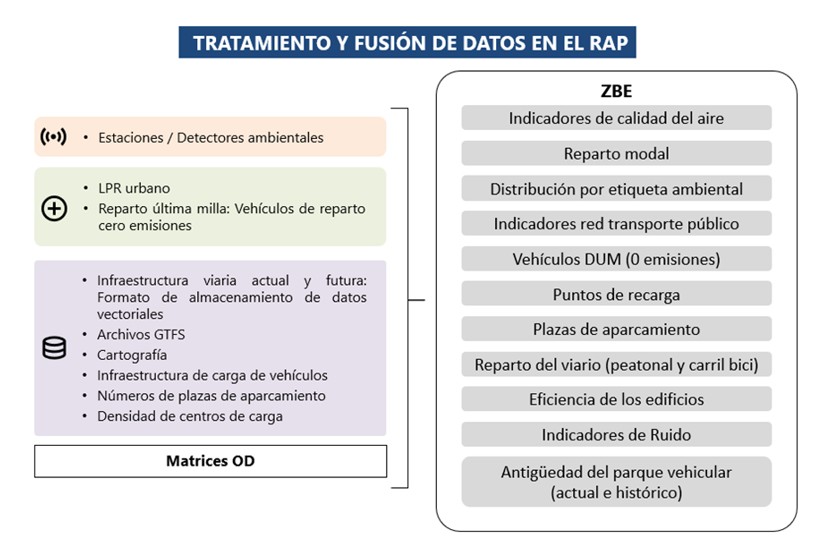
2. Low-Emission Zones (LEZ)

A platform for calculating environmental and traffic indicators, securely and efficiently merging diverse databases.

The platform or demonstration centre to be developed will contain the raw data sets and will provide the services required to merge these data sets in order to calculate the indicators needed to monitor Low Emission Zones (LEZs) effectively.

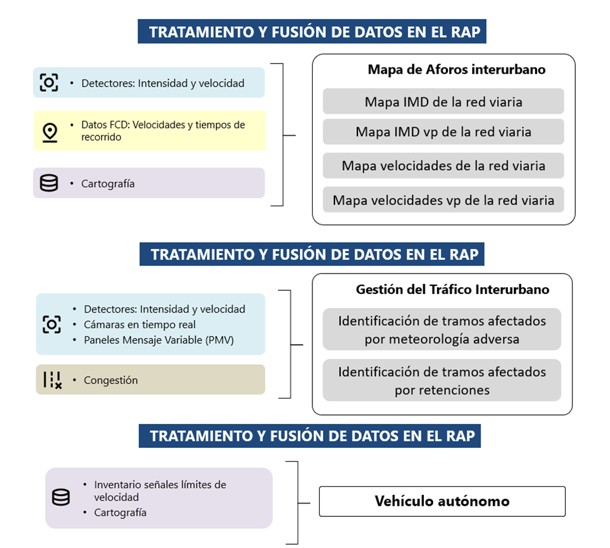
3. Intercity Traffic and ITS

Access to data on average speeds, ITS equipment, incidents and more, for smoother and safer intercity travel, particularly for autonomous vehicles.

The platform will enable users to view average speed data for licence holders for whom this information is available.

The platform will enable users to view information on ITS equipment on the road, traffic incidents, affected sections, etc.

The RAP will contain the essential information needed to facilitate the movement of autonomous vehicles in complete safety.

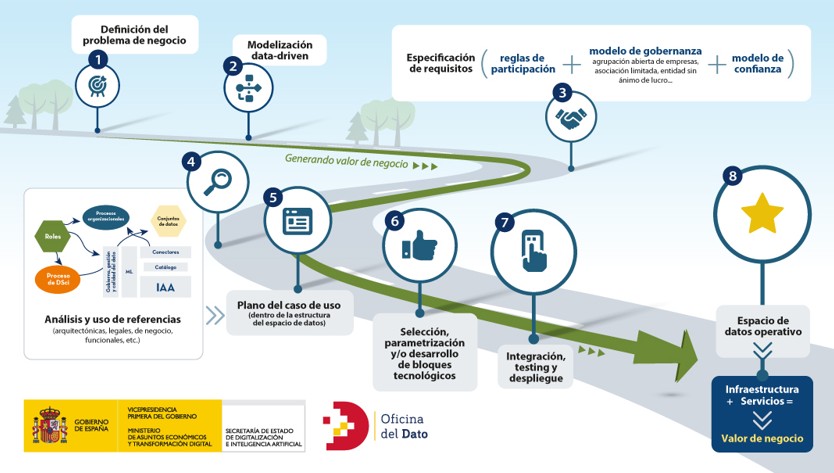
DEVELOPMENT MODEL FOR A USE CASE WITHIN AN INTEROPERABLE DATA SPACE

Definition of the business problem
Clear identification of the challenges or needs to be addressed using mobility data.

Data-driven modelling
Application of a data-driven approach to devise effective solutions.

Consensus on the specification of requirements
Joint establishment of the rules for participation, governance and the trust model amongst the stakeholders involved.

Design of the use case plan (Phases 4 and 5)
Documentation of the technical, legal and operational requirements necessary for implementation.

Selection, configuration and/or technological development (Phase 6)
Selection of the most suitable technological building blocks and development where necessary.

Integration, testing and deployment (Phase 7)
Verification of correct operation and integration within the digital environment.

Operational data space (Phase 8)
Launch of the data space, generating value through services and interoperable access.

Key components of the demonstrator

Interoperability: Any data, any provider, any consumer.
Sovereignty and Security: Trust, traceability and control over data use
Data Value: Derived services, metadata, marketplace.
Governance: Operational models, contracts, agreements, sustainability.

Training and knowledge transfer

Knowledge is the foundation of transformation.

This includes the launch of the Specialisation Diploma in “Smart Mobility Management and Data Space”, aimed at professionals and technical staff in the sector.

Furthermore, the project includes an ambitious plan to boost engagement and provide training for data providers and public authorities.