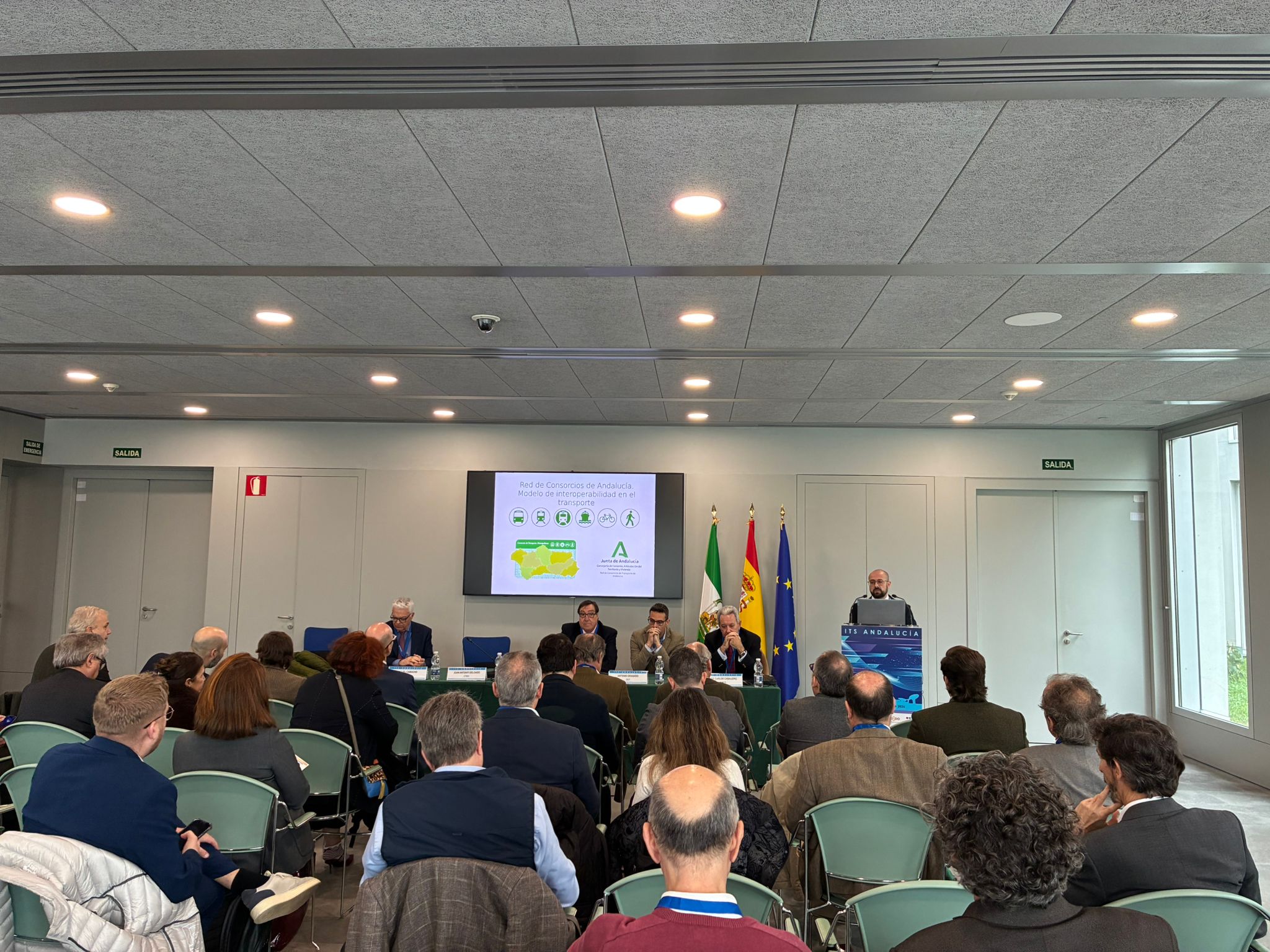
Seville, 18 February. The ITS Andalucía Seminar brought together administrations, operators, and technology companies in Seville to analyse the most significant advances in smart mobility and infrastructure modernisation. The meeting highlighted the strategic role of data, interoperability, and public-private collaboration in building a more efficient, safe, and citizen-oriented transport system.
Intermodality and public transport The session began with an overview of the Andalusian mobility ecosystem, a territory with 8.6 million inhabitants and more than 447 million annual trips on public transport. As 91.5% of these journeys are concentrated in metropolitan areas, solid coordination between administrations is required.
In this context, the Network of Transport Consortia of Andalusia has consolidated itself as a national benchmark. Its nine consortia, which coordinate 231 administrations, operate through a common technological architecture that allows full interoperability between modes. At the close of 2025, Andalusia has 4.1 million active cards, valid on buses, metros, trams, commuter trains, and maritime transport. Upcoming milestones include the Single Andalusian Card (Tarjeta Andaluza Única) and the connection to the future Public Transport Control Centre.
Smart ports and logistics digitalisation The Public Ports Agency of Andalusia presented its strategy to transform the region’s 25 autonomous ports into smartports. The Port of Huelva, immersed in a digitalisation process for the past six years, has become an advanced node within the international logistics chain.
Its model is structured around three pillars: technology and measurement to advance towards a “single data source”, safety and sustainability, and open, citizen-oriented governance. Projects such as Hélice and Faro will enable the unified management of public goods, berth optimisation, and smart guidance, while the FIWARE platform and port ontology have created a collaborative ecosystem that drives advanced applications and paves the way towards the Physical Internet.
Traffic management and smart mobility The DGT (Directorate-General for Traffic) outlined the challenges arising from the increase in long-distance journeys, which exceed 110 million annually. Management is coordinated through eight Traffic Management Centres operating 24/7, supported by ITS systems, continuous monitoring, and citizen information.
Tools such as the National Access Point (eTrafic), the SCADA platform, or DGT 3.0—which integrates the connected V16 beacon—help improve safety and efficiency. Artificial intelligence is already being applied in video analytics and predictive models, such as the one developed for the Straits Crossing Operation (Operación Paso del Estrecho), which is capable of anticipating the arrival of vehicles at the Port of Algeciras with high precision.
Car parks as mobility hubs AUSSA demonstrated the evolution of car parking into a digital ecosystem based on frictionless access, automatic payments, and an app that centralises services such as AI-driven occupancy prediction or electric vehicle charging management. Innovative models like the Aparcamiento 24 Plus at Seville Airport or modular, sustainable solutions reflect this transformation.
Digital Twins and data spaces The Public Works Agency presented its Digital Twin project for the Granada Metro and the Trambahía (Bay of Cádiz Tram-Train), based on BIM, GIS, IoT, and robust data governance. The IDEW middleware will enable progress towards predictive maintenance.
The closing of the seminar highlighted the role of data spaces and National Access Points, which are essential for standardising information and guaranteeing equitable access. The final message was unanimous: the mobility of the future is built through collaboration, with the citizen at the centre.